


BEIJING--(BUSINESS WIRE)--From May 16 to 20, the 2026 ASC Student Supercomputer Challenge (ASC26) Grand Finals will be held at Wuxi University, bringing together 25 finalist teams selected from more than 300 participating universities worldwide. During the on-site competition, teams will independently design and deploy small-scale supercomputing clusters under a strict 5000W power constraint. They will complete a range of advanced computing challenges and deliver presentations showcasing their technical achievements and innovation, while competing for honors including the Championship and Runner-up titles, the Group Competition Award, the e Prize Challenge Award, Highest LINPACK Award, and the Best Presentation Award.
Elite Universities Compete at the Forefront of AI and Scientific Computing Excellence.
This year’s Final challenges are focused on the frontiers of science and technology, including artificial intelligence, space exploration, quantum computing, and climate modeling. The competition problems include LeWorldModel, the latest world model developed by the research team led by Yann LeCun, who is widely recognized as a pioneer of modern computer vision; AMSS-NCKU, a numerical relativity application derived from advanced research in general relativity; QiboTN, a quantum circuit simulation framework built on tensor network architecture; and UnifoLM-WMA-0, a challenge focused on optimizing world model inference acceleration.
When some of the world’s most creative university students confront highly complex scientific and engineering problems, the outcome of the competition becomes exceptionally difficult to predict. Will Tsinghua University, a multiple-time champion across the world’s top three supercomputing competitions, and Peking University, the two-time consecutive ASC champion, continue their dominance? Can defending champion Shanghai Jiao Tong University retain its title? Meanwhile, strong contenders including Zhejiang University, National Tsing Hua University, and Friedrich-Alexander University Erlangen-Nürnberg, together with first-time finalists such as Fudan University, The Hong Kong University of Science and Technology (Guangzhou), and Wuxi University, do add further anticipation and suspense to this high-stakes computational showdown.
Five Groups Compete in the Advanced Simulation of Digital Twin Earth.
The ASC26 Grand Finals will continue to feature the Group Competition, with its results contributing to the overall final score. The 25 finalist universities will be randomly assigned, through a drawing process, into five collaborative teams. Each group will jointly undertake the challenge of optimizing ICON, the climate modeling application recognized by the Gordon Bell Prize for its outstanding achievements in high-performance computing.
ICON is the world’s first fully integrated Earth system simulation to achieve ultra-high spatial resolution at 1.25 kilometers and is widely regarded as a prototype for a “Digital Twin Earth.” The application plays a critical role in global and regional climate modeling, numerical weather prediction, and future climate scenario forecasting.
From static visualization to dynamic simulation, the ICON model enables The Blue Marble (Earth system) to be realistically represented within the digital world. Through collaborative innovation, university students from around the globe are encouraged to explore breakthroughs in the long-standing technical tradeoff between ultra-high resolution and full system completeness in Earth system simulations.
Turing Award Laureate Leads an Open Showcase for In-Depth Technical Exchange.
This year’s ASC Grand Finals will further enhance its communication and presentation format through the introduction of the “Best Presentation Award” and by relocating the jury defense sessions to a fully open exhibition area.
All 25 finalist teams will present at their individual booths through posters and multimedia demonstrations, showcasing their cluster architectures, optimization strategies, and competition results to expert judges, participating institutions, and on-site audiences.
A panel of experts led by Jack Dongarra, Turing Award laureate and Emeritus Professor at the University of Tennessee, will engage in in-depth discussions with each team. This fully open interaction format is designed to foster academic exchange, while strengthening the international communication and collaboration skills essential for the finalists’ future participation in complex scientific and research endeavors.
From Competition to Career — On-Site Recruitment by Leading Enterprises.
The ASC26 Finals will collaborate with leading enterprises in the fields of supercomputing and artificial intelligence to organize on-site talent recruitment activities. All participating teams and visiting observers will have the opportunity to engage directly with leading companies, explore career pathways, and potentially secure employment opportunities, enabling a meaningful transition from academic competition to real-world industrial engagements.
5000W Power Limit Pushes the Frontiers of Hardware–Software Co-Optimization
To encourage students to gain hands-on experience in real-world cluster construction and optimization practices used in production and research environments, and also addressing the growing power consumption challenges of modern computing platforms, this year’s ASC Grand Finals increases the total cluster power limit to 5000W, while requiring configurations consisting of at least three cluster nodes, with a maximum power limit of 2000W per node.
This expanded power framework provides teams with greater flexibility in system architecture design. How each team balances computational performance and energy efficiency through hardware–software co-optimization, and the level of performance breakthroughs they ultimately achieve, will represent one of the major technical highlights of the competition.
About ASC:
The ASC Student Supercomputer Challenge serves as an international platform for technical exchange and the development of the next generation of supercomputing talent with broad support from leading experts and institutions across Asia, Europe, and the United States. Through a rigorous, hands-on competitive format, ASC aims to advance academic excellence and practical skills in supercomputing application development and research, positioning high-performance computing as a catalyst for scientific discovery, technological progress, and industrial innovation. Now in its 13th edition, the ASC Student Supercomputer Challenge has engaged tens of thousands of university students from six continents, establishing itself as the world’s largest student supercomputing competition. Learn more about this exciting competition on the official website: http://www.asc-events.net/StudentChallenge/index.html
Contacts
Media contact
media@asc-events.org
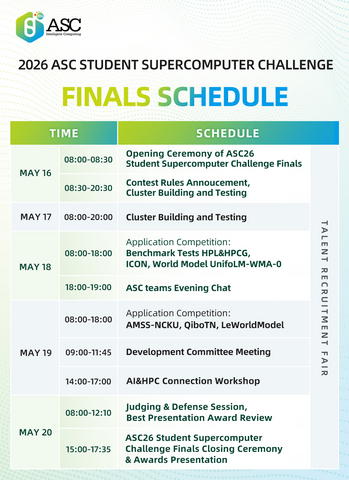
ASC26 Student Supercomputer Challenge Finals Schedule